Goddard Space Flight Center and Southwest Research Institute logos + View the NASA Portal
IBEX
 

How does the Solar System boundary affect me?

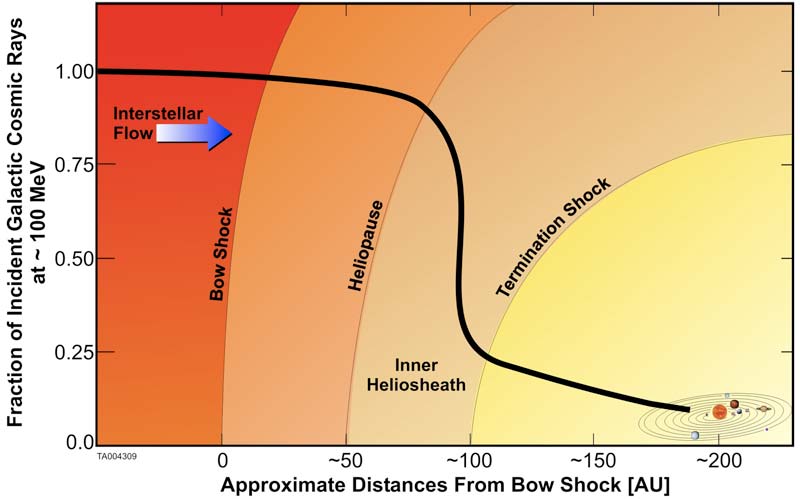
Fraction of Incident Galactic Cosmic Rays vs Distance

This graph depicts the fraction of high energy cosmic rays (greater than 100 MeV) that pass through the boundary of the solar system. 100% of them are present outside of the Bow Shock. There is a small dropoff in the number that make it through to the heliopause. More than 50% are stopped between the heliopause and termination shock, which is at approximately 100 AU. This leaves a fraction less than 25% to permeate to the inner solar system.


The Solar System boundary may be defined as the region where the Solar Wind slows down and interacts with the Interstellar Medium.

If the Solar System did not have a boundary, or if the boundary changed size so that it was inside the orbit of the Earth, then there would be at least 4 times the amount of cosmic raysCharged atomic particles moving in space with very high energies (the particles travel close to the speed of light); most originate beyond the solar system, but some of low energy are produced in solar flares. in the Solar System. Luckily the Earth's magnetosphere protects us from some of the cosmic rays that come from outside our Solar System. However, if there were a dramatic increase in the number of cosmic rays entering the solar system, it could change the amount of high energy cosmic rays that would be able to reach Earth's surface. Damage to the Earth's ozone layer could occur and cosmic rays may cause damage and mutation to DNA.

 
NASA Principal Investigator: Dave McComas
E/PO Lead: Lindsay Bartolone
Webmasters: Wendy Mills & José Francisco Salgado
Last Updated: 1 OCTOBER 2009
+ Contact Us